
Team Redpoint,
As I wrote to Santi, I run an informatics startup that’s working to unstick some holy-grail bottlenecks in biomedical research (and other analytical chemistry). We’ve spent the last couple years building a technical proof of concept, we’re thrilled with the results and promise of that work, and we’re looking to scale up R&D to put a mission critical tool in the hands of researchers around the globe. We’ve summarized of our project in this Y Combinator format (below) because it’s concise and portable. Of course there are many other details, and many other ways to tell this story, but I wonder if you’d consider this brief overview as a proposal to chat? Does this look like the sort of purpose-built SAAS project that might warrant a discussion? We’d love to talk to you.
These are Y Combinator questions and our answers…
So, what is MS Orchestra? (3 mins)
MS Orchestra is missing-link analytical software (SaaS) to accelerate biomedical research around the globe.
Whole fields of biomedical research have been bogged down by chronic gaps in analytical chemistry: Mass spectrometry enables modern “omics” to discover new diagnostic patterns in physiology, but then the power of mass spec fizzles out at the point of identifying the molecular compounds that make up those patterns. Science has a serious “compound ID” problem, and it’s impeding research around the globe.
① MSO is a little like Shazam for mass spectrometry data
Much like Shazam can serve up the name (identity) and lyrics (metadata) of a song that’s flowing out of speakers when you hold your phone up to the sound (by making a sonogram and deploying some pattern-matching software in a database of songs), MS Orchestra will serve up the name and metadata of chemical compounds that are detected in 5+ dimensions of mass spec data that have previously been difficult to integrate and operationalize. This is a holy grail problem in analytical chemistry. Our approach uses a novel mass-spec foundation model and graph DB technology to enable long overdue search and sophisticated informatics.
② It’s like Wikipedia for mass spectrometry insights
Much like Wikipedia is a central clearinghouse to assemble and organize humanity’s distributed nuggets of expertise, so will MS Orchestra be a central clearinghouse to assemble and OPERATIONALIZE humanity’s vast collection of mass spec databases and insights. This is indispensable to a research community seeking better coordination and more speed.
③ It’s like WordPress for mass spec algorithms and reference libraries
Much like WordPress is a foundational RUNTIME platform to run specialized programs and utilities as “plugins” to a coherent content management system, MS Orchestra will activate and operationalize dozens of valuable open-source resources that were created to help research — but are currently languishing for lack of any practical runtime framework.
MS Orchestra is a ‘digital picks and shovels’ proposition for the $6B global mass spec market, which is growing rapidly — but is constrained by ⓐ fundamental gaps in analytical capability and ⓑ technical expertise required to perform basic operations at large scale.¹ MSO data systems allow faster, more reliable analytics by less-skilled workers — blazing a path to more productive research and faster market growth. We’re serious about accelerating cancer research. As a side effect, we’ll accelerate the rest of analytical chemistry, too.
_____________________________
¹Quoting Markets and Markets”Challenge: Dearth of Skilled Professionals
The mass spectrometry market is facing a challenge due to the dearth of skilled professionals. Mass spectrometry is a complex and precise analytical technique, and requires highly trained and experienced personnel. The lack of qualified professionals is a major impediment to the growth of the market.”
(https://www.marketsandmarkets.com/Market-Reports/mass-spectrometry-market-437.html)
What do target users think about the MS Orchestra project?
We periodically ask experts in the field to evaluate our ongoing work. These are excerpts from some those conversations.
Who are the founders? (1 min)
Founder bios.
| Matt Rain EDUCATION University of Idaho PHD Molecular Genetics ’93–’00 Tufts University BS Biology ’88–’92 WORK EXPERIENCE Vaccinated.US — Executive Director / Artist in Residence Aug ’20–Present MS Orchestra — President May ’19–Present Agilent Technologies — Worldwide Biopharma Commercialization Manager Aug ’15–Apr ’19 Agilent Technologies — Worldwide Life Sciences Education Manager Feb ’02–Aug ’15 University of Washington — Research Scientist Jan ’99–Jan ’01  Please tell us about another project, other than this startup, that provided valuable learning. ① Big project management, big vision, big lessons: In 2015 my wife and I barged a million-pound historic brick house from the shores of Lake Washington (Seattle) across Puget Sound to Bainbridge Island. We GCd and managed this extraordinary construction project, hired/managed crews, and then we rolled up sleeves to swing hammers and turn screws with our team. A time-lapse video of the house-move project is online at https://youtu.be/Y_sg6fTsVQg. ② Globally collaborative: During CoViD19 pandemic I made art from 3D molecular structures of the SARS-CoV2 spike protein (before vaccines were political). Later, when vaccines went vitriolic, I stuck some of the molecular art on t-shirts and offered it to the world as a symbol of public-health rationality — and a fundraiser for helpful science communication outlets. We’ve sold spike protein art in 24 countries and 48 US states, and made a bunch of cool friends in the process. Project web site: https://Vaccinated.US Interesting article on the project: https://misinformationkills.substack.com/p/emerging-psychology-of-vaccine-resistance Podcast appearance on This Week in Virology: https://youtu.be/AxjQB2gzG6g?t=155 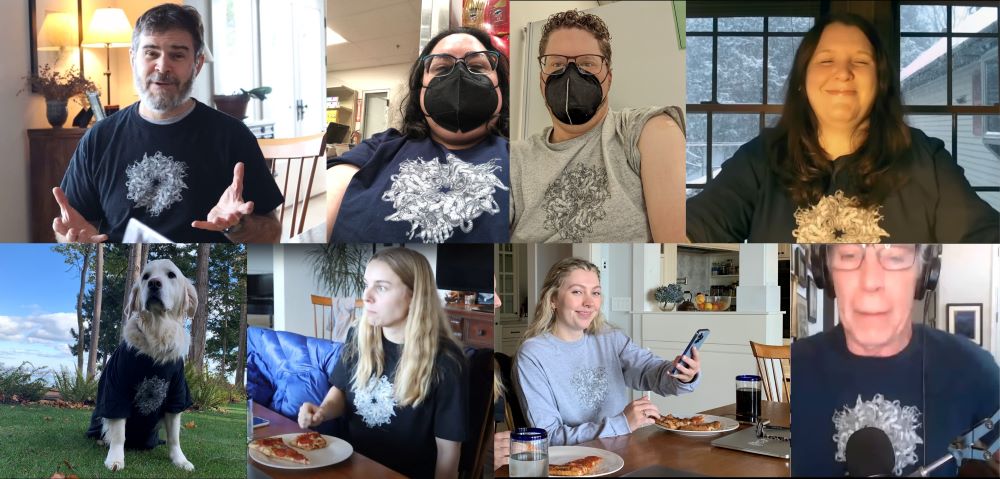 |
| Quinnlan Rain EDUCATION University of Washington BS Double Major: 1) Biochemistry 2) Molecular, Cellular And Developmental Biology ’15–’19 WORK EXPERIENCE MS Orchestra — Software Engineer Aug ’18–Present Center for Urban Waters — Contractor Mass spectrometry informatics software designer/programmer Seattle Children’s Hospital — Research Intern Feb ’17–Jul ’18 Lab technician in CAR-T cell-therapy research lab Please tell us about another project, other than this startup, that provided valuable learning. I built a custom software application for environmental chemists to streamline their compound-ID workflow at the Center for Urban Waters. That team of chemists wrestles with the same challenge that everyone fights in the mass spec world: analytical processes to identify unknown compounds in mass spec data are urgent, convoluted, time-consuming, and ~100% error-prone. Those chemists asked me to build a tool that would make some tedious steps in existing workflows easier. I built them the tool that they requested, they like it, but it’s lipstick on the pig of traditional compound ID workflows. It only got them a simpler process to execute deeply flawed techniques. Those observations became the roots of the MS Orchestra project that is outlined in this application. |
Who writes code, or does other technical work on your product?
MS Orchestra combines three sophisticated code streams from three synergistic projects to make one game-changing solution for next-gen “omics.”
① The graph computing layer was invented and built in Washington by our (separate) sister startup. This is a uniquely capable graph database platform with umatched DB sharding and parallel processing capabilities. We believe it’s more flexible and powerful than better known graph DB platforms like MongoDB or Neo4J. Our graph computing partners hold several patents on their graph DB IP.
② The MS Orchestra Layer is a symphony of novel Java and Python code that was developed by Quinn Rain — MSO cofounder (see founder vid, just above). An MSO proof of concept currently works as an application of the Point of Data Graph DB.
③ The MZmine Layer:
Our new, sophisticated back-end technology needed front-end visualization tools that are specific to mass spec data and workflows. Rather than reinvent those visualization tools that have been built many times before, we’re integrating the many years of code embodied in the globally familiar, widely beloved, open source (MIT licensed) visualization package called MZmine. That package has been under continuous development and refinement for ~20 years by a worldwide community of academic developers, and their MIT license allows us to integrate a powerful/sophisticated GUI right out of the starting gate (featured in demo vid). Since MZmine fundamentally lacks all the back-end capabilities that MS Orchestra has invented, integrating MSO with MZm is a synergistic match made in heaven.
How long have the founders known one another and how did you meet?
We are father and son. We’ve known each other for all of Quinn’s 28 years.
During Quinn’s childhood I worked for an international mass spectrometry vendor and traveled too much. As a lad Quinn was a math prodigy, and he often heard me opine: In the world where I work we have genius chemists, and genius computer programmers, but we struggle mightily to find truly integrated “chemist-programmers.” As a consequence there was always a game of “telephone” distorting and constraining the creative process of making complex software for analytical chemistry. At an early age Quinn declared, “I’m going to be that guy.” And then he did it. After studying biochemistry and applied math at the University of Washington, Quinn did an internship at a UW mass spec lab to study data structures, and he grew to understand my old gripe. He also wrote great software for that group. MSO grew out of that work.
Cancer
When Quinn was 13 his best childhood friend developed Ewing’s sarcoma, which introduced new perspective on disease, amputation, and mortality. That perspective rippled out to influence his dreams, concerns, and ambitions. He and I are committed to doing everything we can do on this earth to accelerate cancer research. We believe MS Orchestra can be a substantial contribution to accelerating the work of specialized researchers around the globe.
Project progress
How far along are you?
• We’ve assembled more than 2 million mass spectra, for over 600,000 different chemical compounds from different public libraries around the world.
• We’ve established that 100% of the public reference spectra previously had incomplete records that constrained the functional logic that could be applied to searching them and organizing search results. Then we completed all those records to enable next-gen search.
• We learned that hundreds of published reference spectra had data entry errors, then we fixed those errors.
• We’ve indexed the world’s cleanest copy of published reference spectra in a powerful graph computing platform that allows search thousands of times faster than any alternative we’ve seen.
• In a space with many names for each chemical structure, where chemists cannot compare search results to distinguish similar search results from different results, we invented a novel, proprietary framework to reconcile and normalize results for universal coordination.
• Because we have the only framework for reconciling similar/different search results we could integrate many different libraries and search platforms, and return search results in a unified, harmonized report to produce the most comprehensive compound-ID search platform available.
• We’ve created the world’s most valuable training set for future products but, in the process, we’ve created a technology with immediate scientific value that we’ll deploy as a first-version MVP to support product evolution.
Sometimes the coolest product is just the thing that people really need. In this case, we believe it’s also a technology that can accelerate cancer research worldwide, and make an industry-leading business in the process.
When will you have a version people can use?
2 months to beta, 4 months to MVP.
Idea
Why did you pick this idea to work on? Do you have domain expertise in this area? How do you know people need the thing you’re making?
During my 17 years working for a global mass spectrometry vendor, I worked with customers, application scientists, and R&D gurus around the world. Those people live on the cutting edge of biomedical research (and pharma, environmental chemistry, etc.). They are driven by the promise of mass spectrometry, but they are frustrated by fundamental gaps in tools for data analysis. The American Society for Mass Spectrometry occasionally polls members and finds “data analysis” to be a #1 frustration in the community.* The scientific literature is full of hand-wringing about informatics gaps. The mass spec world has holy grail problems that are widely recognize, and we’re looking to address them directly.
Incremental advances on those problems are published in top-tier journals like Nature Biotechnology because they are so closely followed. When we encountered a confluence of technologies, strategies, and people that offered radical new solutions to those chronic old problems, we decided we had to step up and build the solution.
*This paper summarizes an ASMS working-group summary of the headaches.
https://drive.google.com/file/d/1-nOeBxhf_xBVmizZrWxpGB9Xfzzu2GVG/view?usp=sharing
The MS Orchestra project is designed to provide substantial forward progress on those issues.
Who are your competitors?
What do you understand about your business that they don’t?
The mass spectrometry world is FULL of software applications and reference materials. Are they competitors? Kind of…
Those resources were produced by mass spectrometry vendors and academic scientists — and that COLLECTION grew up as a bunch of disconnected projects for individual narrow tasks in the early days of mass spectrometry. This cacophony of tools now defines the competitive landscape, their incoherence is a second-order problem, and that is also a big part of the opportunity. It takes too many different software applications to accomplish the simplest tasks. What’s more, many applications require users to:
• Convert data formats back and forth to accommodate different tool(s)
• Guess at a bunch of data parameters for pre-processing data
• Retain and organize the many differently formatted versions of the same data to move back and forth around a workflow
• Accept data error and artifacts that arise from that shoot-from-the-hip parameter estimation and the version-control mess implicated above.
This target market is frustrated. Not only are available informatics tools cumbersome… they STILL DON’T ACHIEVE THE GOALS. Users cannot easily run a search that reliably finds the identity of compounds they have detected. Users cannot search their own archived data using obvious data parameters for search inputs. Users cannot easily pre-process/normalize/deconvolute their data with mathematically rationalized input parameters. Users cannot easily show auditors (like the FDA) that their data have not been adulterated. It’s a mess.
Humanity’s first round of mass-spec informatics was critical to build a foundation, but the technical debt is now strangling all the pioneers — and their users. The moment just happens to be perfect for someone to step in to sort out the mess with powerful new semantic DB technology and an architecture that can smooth all those wrinkles, and ADD MATH/AI to steps where that is obviously overdue!
How will you make money? How much could you make?
(We realize you can’t know precisely, but give your best estimate.)
I. Revenue
We plan to sell ⓐ analytical software and ⓑ data storage systems to chemists who run multimillion-dollar mass spectrometry labs. In this scientific B2B marketplace, mission-critical software frequently commands 5-figure license fees, and some storage solutions can be one or two orders of magnitude more expensive.
We intend to pursue a “bowling pins” strategy that will target market segments in the following sequence:
1) High resolution LC/mass spectrometry labs first (we currently estimate SAM of 50K labs around the world)
2) “Other” LC/mass spectrometry labs second (estimating >200K labs)
3) Other non-mass spec instrument users that need to operate other instruments in regulated environments (we intend to build a customizable platform that will allow more instrument/data types to MOVE INTO the regulated lab sphere).
Multiplying a 5-figure price tag X 5-figure customer numbers, and considering annual license renewal structures, we are working toward 9-figure annual sales volumes — plus storage solutions that INTEGRATE the analytical capabilities to outcompete and displace older storage strategies.
II. Equity/Exit
MS Orchestra will fill a software niche that will make it valuable and highly attractive as an upmarket acquisition target. This creates strategic options for navigation. Why would MS Orchestra be attractive?
A. We intend to provide an analytical capability that mass spectrometry vendors will want to control and offer to their customers as a competitive lever.
B. There is a brand new social medium component to our business model where scientists can share data — and compare shared data in completely new ways that will give customers new power to see instrument vendor strengths (and shortcomings). Whoever controls our technology will have unprecedented ability to see/understand which customers are using which competitors’ instruments and consumables — and also to see for the first time whose technologies are performing best. This will be the first time that scientists will have the ability and compelling reason to open their kimonos to a central service, much like we all do to Google, Amazon, etc. in the consumer marketplace.
We believe we’ll create a new form of value in that information, and we are developing business models that integrate those considerations.
Where will most of your initial users be located?
Global
Which category best applies to your company?
B2B SaaS for analytical chemists who comprise the $8B mass spec industry.
_____________________________
¹Quoting Markets and Markets (https://www.marketsandmarkets.com/Market-Reports/mass-spectrometry-market-437.html)
“Challenge: Dearth of Skilled Professionals
The mass spectrometry market is facing a challenge due to the dearth of skilled professionals. Mass spectrometry is a complex and precise analytical technique, and requires highly trained and experienced personnel. The lack of qualified professionals is a major impediment to the growth of the market.”